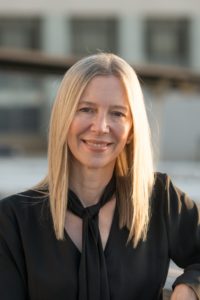
Danielle Tullman-Ercek

After earning her B.S. degree in chemical engineering, Tullman-Ercek began her Ph.D. at the University of Texas at Austin under advisor George Georgiou. Her dissertation focused on the pathway bacteria use to transport folded proteins across membranes, and how this pathway may be used in protein engineering applications. After earning her Ph.D. in 2006, Tullman-Ercek began her post-doctoral work at the University of California, San Francisco in the laboratory of Chris Voigt. Her primary project in the Voigt lab was the study of spider silk production and secretion in Salmonella. She also immersed herself in the challenges and potential of the field of synthetic biology. She continued her postdoctoral studies at the Joint BioEnergy Institute, working to improve enzymes that break down biomass for more efficient and economic biofuel production processes. Tullman-Ercek joined the Department of Chemical and Biomolecular Engineering at UC Berkeley in 2009. Inspired by her previous work, her research group focuses on engineering multi-component systems in biology – such as protein and small molecule secretion machinery and bacterial microcompartments – using tools and techniques from protein engineering and synthetic biology.

EBRC Council Retreat 2021

Wednesday, October 27, 2021: 8:00 AM- 2:00 PM PDT
Thursday, October 28, 2021: 8:00 AM – 2:00 PM PDT

The annual EBRC Council Retreat and planning meeting will be held virtually October 27-28, 2021. This meeting is by invitation only and will be a mix of plenary discussions and extended breakout sessions.

Please register for the meeting and select your breakout session preferences, and indicate your interest in giving a Synergies lightning talk. We will organize breakout sessions based on your preferences, as well as obtaining a mix of academic and industry members, and WG representation. Throughout the meeting, we will identify and integrate opportunities to advance diversity, equity, and inclusion.

Sifang Chen

Arum Han

Dr. Arum Han is a Professor in the Department of Electrical and Computer Engineering and also in the Department of Biomedical Engineering (courtesy joint appointment) at Texas A&M University (USA). He joined Texas A&M University in 2005 as an Assistant Professor. He is also a faculty of the Texas A&M Health Science Center and the Texas A&M Institute for Neuroscience. He received his Ph.D from the Georgia Institute of Technology in 2005, his M.S. from the University of Cincinnati in 2000, and his B.S. from the Seoul National University in 1997, all in electrical engineering.

His research interests are in solving grand challenge problems in the broad areas of health and energy through the use of micro/nano systems technologies. His work in these areas has focused on the development of high-throughput lab-on-a-chip systems for single-cell-resolution assays, synthetic biology and biotechnology applications, as well as development of organ-on-a-chip systems through

He has co-authored more than 80 peer-reviewed publications and has received funding from the Bill and Melinda Gates Foundation, NIH, NSF, DARPA, DTRA, USDA, U.S. Army Corp of Engineers, Qatar National Research Foundation (QNRF), and several other international sponsors and private companies. He currently serves as the editorial board member of the journal PLoS ONE, Algal Research, and Biotechnology and Bioprocess Engineering, as well as associate editor for the journal Biomedical Microdevices.

He is a Texas A&M Engineering Experiment Station (TEES) Fellow (2012), Eugene Webb Faculty Fellow of Texas A&M University (2014), recipient of the Engineering Genesis Award for Multidisciplinary Research from Texas A&M University (2014), recipient of the E. D. Brockett Professorship Award (2015), recipient of the Dean of Engineering Excellence Award (2016), and became the Presidential Impact Fellow of the Texas A&M University in 2017.

Christopher Mason

Dr. Christopher Mason is an Associate Professor of Genomics, Physiology, and Biophysics at Weill Cornell Medicine and the Director of the WorldQuant Initiative for Quantitative Prediction. He also holds affiliate appointments at the Tri-I Program on Computational Biology and Medicine (Cornell, Memorial Sloan Kettering Cancer Center and Rockefeller University), Harvard Medical School, and Yale Law School.
The Mason laboratory develops and deploys new biochemical and computational methods in functional genomics to elucidate the genetic basis of human disease and physiology. We create and deploy novel techniques in next-generation sequencing and algorithms for: tumor evolution, genome evolution, DNA and RNA modifications, and genome/epigenome engineering. We also work closely with NIST/FDA to build international standards for these methods (SEQC2, IMMSA, and Epigenomics QC groups), to ensure clinical-quality genome measurements and editing. We also work with NASA to build integrated molecular portraits of genomes, epigenomes, transcriptomes, and metagenomes for astronauts, which help establish the molecular foundations and genetic defenses for enabling long-term human spaceflight.
Dr. Mason has won the NIH’s Transformative R01 Award, the NASA Group Achievement Award, the Pershing Square Sohn Cancer Research Alliance Young Investigator award, the Hirschl-Weill-Caulier Career Scientist Award, the Vallee Scholar Award, the CDC Honor Award for Standardization of Clinical Testing, and the WorldQuant Foundation Scholar Award. He was named as one of the “Brilliant Ten” Scientists by Popular Science, featured as a TEDMED speaker, and called “The Genius of Genetics” by 92Y. He has >230 peer-reviewed papers and scholarly works that have been featured on the covers of Nature, Science, Cell, Nature Biotechnology, Nature Microbiology, and Neuron, as well as legal briefs cited by the U.S. District Court and U.S. Supreme Court.

Cinnamon Bloss

Cinnamon Bloss, Ph.D. is Associate Professor in the Herbert Wertheim School of Public Health and Longevity Science and Director of the Center for Empathy and Technology at the University of California San Diego. Dr. Bloss is jointly appointed in the Department of Psychiatry and the Division of Biomedical Informatics in the School of Medicine. Dr. Bloss researches social and behavioral phenomena related to emerging technologies, with a particular focus on genetic and genomic research, precision health, and big data. Her research is funded by the National Institutes of Health, the Defense Advanced Research Projects Agency, and philanthropic donations. Dr. Bloss serves as a member of the Novel and Exceptional Technology and Research Advisory Committee, a federal advisory committee that provides recommendations to the NIH Director and a public forum for the discussion of the scientific, safety, and ethical issues associated with emerging biotechnologies. Dr. Bloss has given invited talks at the National Academy of Sciences, Engineering, and Medicine, the National Press Club, the National Institutes of Health, and has presented invited testimony before a Food and Drug Administration Advisory Panel to inform consumer genomics policy. Dr. Bloss was recognized by the Western Societies of Medicine with the Carmel Prize for Research Excellence and has received numerous teaching awards at the University of California San Diego.

Jenny Mortimer

Jenny Mortimer is a Professor of Plant Synthetic Biology at the University of Adelaide, in the School of Agriculture, Food and Wine, and the Waite Research Institute, an Affiliate Staff Scientist at Lawrence Berkeley National Laboratory (LBNL) USA, and the Director of Plant Systems Biology at the Joint BioEnergy Institute, USA.

After completion of her PhD at Cambridge University, UK, she completed postdoctoral training in the UK (also at Cambridge University), a fellowship at RIKEN, Japan, and then a move to LBNL as a Research Scientist. She relocated to Adelaide in 2021.

Her team’s research focuses on understanding and manipulating plant cell metabolism, with a focus on complex glycosylation. The goal is to develop crops which contribute to a sustainable and renewable bioeconomy. In Adelaide, her new group is using synbio to develop new crops (such as duckweed) for food and novel materials production in controlled growth environments – including for Space settlement. Other projects include engineering glycans to deliver plants with increased (a)biotic stress tolerance. In the US, her group works to reengineer the plant cell wall for the sustainable production of fuels and biochemicals from biomass. Her lab is also developing new synbio and bioinformatics tools for bioenergy crops, and investigating the role of plant cell walls in recruiting and retaining the rhizosphere microbiome, She was selected as a World Economic Forum Young Scientist (2016/17), where she contributed to the WEF Code of Ethics for Researchers (widgets.weforum.org/coe), and she is a Handling editor for Plant Cell Physiology. Twitter @Jenny_Mortimer1, and more about her research here: mortimerlab.org .

Cong Trinh

Dr. Cong T. Trinh is an Associate Professor in the Department of Chemical and Biomolecular Engineering at The University of Tennessee, Knoxville. Dr. Trinh earned his B.S in Chemical Engineering (summa cum laude, honors thesis) with minors in Chemistry and Mathematics from The University of Houston and his PhD in Chemical Engineering from The University of Minnesota-Twin Cities. He then worked as a post-doc scholar at The University of California, Berkeley.

EBRC SPA presents Follow the Money Panel

The EBRC Student and Postdoc Association is hosting a panel discussion called Follow the Money for researchers to understand the science funding pipeline for engineering and synthetic biology. Join us virtually on October 18th, 2021 (12:00-1:30pm ET | 9:00-10:30am PT) on Zoom by registering here. Our diverse panel includes a broad range of perspectives from the congressional, project management, and advocacy levels to provide a full-circle overview on how research priorities go from expert opinion to budget items to grants to research labs and back.

Click here to view our flyer.

Please contact Julie Ming Liang (julieliang2022@u.northwestern.edu) if you have any questions.