BioBuilder Teacher Training Workshops

Attention all teachers: There are still open spots for BioBuilder’s three-day professional development workshops this summer! Tuition scholarships are available. See the BioBuilder Professional Development website for more info.

New publication from Jewett Lab

A new publication from Jessica Stark (Mike Jewett‘s lab at Northwestern Univ.) describes the use of cell-free synthetic biology in easy-to-use educational kits for teaching CRISPR and antibiotic resistance to high schools students. Check out the paper in ACS Synthetic Biology.

[VIRTUAL] EBRC 2020 Annual Meeting

While we are disappointed that we have been forced to cancel our annual meeting in Houston, we would like to take advantage of the blocked time on your calendar by conducting a number of activities, including our Working Group meetings, in a virtual format. These meetings will be held consecutively to facilitate participation by any members that care to join. We encourage any and all of you to listen in to those working groups that may be of interest to you. This is a great opportunity to get involved with what we’re doing. Below is full list of EBRC activities including:

  • Working Group Meetings
  • Student and Postdoc Association SBIR Workshop
  • Virtual Seminar Series
  • Review of an EBRC ethics statement
  • Virtual Poster Session

Here are the schedule and registration links for the Working Group meetings and SPA workshop:

Thursday, April 2nd

Friday, April 3rd

Please use the links to register for the meeting or meetings you intend to attend. A calendar invite containing an agenda and ZOOM information for each event will follow shortly.

SPA Workshop/Panel:
How to Apply for a Small Business Innovation Research (SBIR) Program Grant

Are you a graduate student or postdoc interested in entrepreneurship or looking to commercialize your research? Join the SPA for a panel on the Small Business Innovation Research (SBIR) program, a federal program that provides funding for startups and small businesses to engage in innovative research and development with commercialization potential. Our panel features Dr. Erik Pierstorff (SBIR/STTR Program Director at the National Science Foundation), Dr. Rachel Jordan (Research Scientist at Lynntech, Inc.), and Dr. Michael Heffernan (Principal at Fannin Innovation Studio).

Weekly Seminar Series:
In order to supplement the departmental seminars that have been cancelled in recent days, the EBRC will be holding a Weekly Seminar Series. We will be reaching out to the speakers we had scheduled for the annual meeting to begin building the program. But please feel free to connect me with colleagues interested in speaking to us, EBRC members or not. The times will be Tuesdays at 11:00 AM (PDT) one week, and Wednesdays at 1:00 PM (PDT) the following week, alternating for the duration of the program. This alternating schedule will allow the majority of members to attend at least every other week, despite class schedules. A schedule of dates and speakers will be published on ebrc.org prior to the virtual meetings.

EBRC Ethic Statement:
The EBRC Security Working Group has been developing an Ethics statement for the Consortium. The statement as well as background and framing information will be distributed on Friday March 20, 2020. We request that the other Working Groups dedicate some portion of their time to reviewing and commenting on this statement. The Security Working Group will address comments and work with Working Group Chairs and interested parties to produce a “final” version to be socialized with the whole of the membership prior to publication on the website. We look forward to your input and comments.

Virtual Poster Session:
In lieu of a poster session at the Annual Meeting, we are organizing a virtual “poster hall” that will be available from March 31 through April 3. Presenters will be asked to send a poster PDF or 4-5 PowerPoint slides to helix@ebrc.org by 11:59 PM PDT on March 29. Alternative media formats (e.g., a 5-min Zoom presentation or Prezi presentation) are welcome as supplements. On March 31, links to view posters on Google Drive will be provided to those who register for the poster session. By managing permission settings for viewing the posters, we aim to limit dissemination beyond those associated with our meeting. However, we recognize that some may not feel comfortable with unpublished work being available online, even to a restricted group. If that is the case, presenters should focus their posters on previously published data.

On Thursday April 2 after the working group meetings, we will host a live poster session using Zoom. Presenters will be divided into small groups (3-4 people) and assigned to a Zoom discussion room. Attendees will be able to enter rooms to speak with poster presenters.

General instructions about the ZOOM platform will be distributed shortly. Specifics on the working group sessions will be sent out by the chairs of those groups prior to the meeting. We look forward to your participation in moving forward the goals of our field.
EBRC Seeking Science Policy Postdocs

UC Berkeley and the Engineering Biology Research Consortium (EBRC) are seeking postdoctoral scholars interested in science policy. Learn more and apply today.

Global Biofoundry Alliance Launches

A group of over 15 biofoundries from around the world came together in in Kobe, Japan to launch the Global Biofoundry Alliance. Read more about it in Nature Communications.

SynBioBeta 2019: The Global Synthetic Biology Summit

SynBioBeta is where tech meets bio and bio meets tech. Meet the innovators and companies, find new opportunities, partner up and discover the potential of the biological industrial revolution. Join attendees on October 1-3, 2019 in San Francisco to see how synthetic biology is disrupting consumer products, food, agriculture, medicine, chemicals, materials, and more.

Seeking participants for “EBRsee” outreach initiative!

EBRsee will be a series of videos and podcasts for the public. If you are interested in participating or to learn more, please contact education@ebrc.org.

Artificial Photosynthetic Cell Producing Energy for Protein Synthesis

Samuel Berhanu, Takuya Ueda, Yutetsu Kuruma. Nature Communications.

Skype A Scientist

Skype a Scientist matches scientists with classrooms around the world!

Syllabus: Protein Engineering Syllabus (Northwestern CBE 395)

Exam materials: Protein Engineering Midterm

Homework or recitation worksheets: Protein Engineering Design Challenges

Jussi Jantti

Mike Fero

Michael Fero is a Co-Founder and CEO of TeselaGen Biotechnology Inc., a San Francisco based software company that has built Synthetic Evolution® – the AI driven operating system for synthetic biology. Michael received his Ph.D. in Physics from the University of California and contributed to the verification of the Standard Model at CERN and SLAC via the world’s most precise measurement of the Weinberg angle governing the coupling between the electromagnetic and weak interactions. Dr. Fero’s interest in biology led to a collaboration with Pat Brown and David Botstein at Stanford to build the world’s first human genome microarrays and do early research on expression level characterization of cancer cells. Dr. Fero then turned to systems biology where, in collaboration with Lucy Shapiro and Harley McAdams, he developed an automated high content diffraction limited microscopic screen of triply fluorescently tagged bacteria to better understand the bacterial cell cycle. Afterwards, Dr. Fero and two Stanford Shapiro/McAdams Lab colleagues started TeselaGen Biotechnology as a way to accelerate synthetic biology and the bio-based economy. Seeing a big deficiency in biologists’ ability to create what they imagine, TeselaGen focuses on making the mind to molecule process easier and faster with an AI driven, cloud-based enterprise platform for synthetic biology.

Carrie Cizauskas

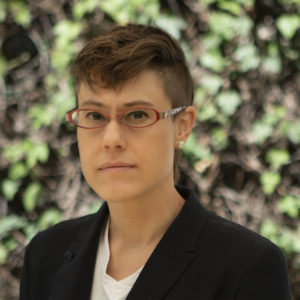
Carrie Cizauskas holds a veterinary degree (DVM) from Cornell and a PhD in disease ecology from the University of California Berkeley. Carrie started doing research as an undergraduate at the University of Wisconsin, Madison, completing a senior honors thesis on the immunology of malaria and earning the College of Letters and Science Dean’s Prize. Their veterinary work focused on wildlife and population medicine, leading to NIH EEID-supported graduate research in the Wayne Getz lab in the Department of Environmental Sciences, Policy, and Management at Berkeley on the ecological immunology and physiology of environmentally-transmitted coinfections in wildlife. Carrie did a Grand Challenges-supported postdoctoral fellowship at Princeton with Andy Dobson and Andrea Graham, researching interactions between the gut microbiome and macroparasites in wild non-human primates, and examining issues of infectious disease eradication and conservation. Carrie then made the leap from academia to industry, and now works as the Manager of Publishing and Academic Relations at Zymergen. As such, they work across the company to determine how to analyze data from interdisciplinary projects and publish on research involving microbiology, molecular biology, chemistry, data science, machine learning, and automation.

Ken Oye

JL Clem Fortman

Clem Fortman

J. L. “Clem” Fortman is a synthetic biologist with a long standing interest in biodefense. He is currently a staff member at the EBRC, and was formerly a technical analyst for synthetic biology with ANSER providing support to the Office of the Deputy Assistant Secretary of Defense for Chemical and Biological Defense, where he previously served two years as an American Association for the Advancement of Science (AAAS) Science and Technology Policy Fellow. He is also a former Fellow with the Emerging Leader in Biosecurity Initiative at the Johns Hopkins Bloomberg School of Public Health Center for Health Security. Clem is a classically trained microbial physiologist with a PhD in microbiology from the University of Minnesota. He spent 6 years as a postdoc in the University of California, Berkeley (UCB) Department of Chemical Engineering where he gained his expertise in synthetic biology. He is a founder of the introductory College-Level Experience in Microbiology (iCLEM) program at UCB, an educational outreach program for under resourced high school students, as well as Lygos, a San Francisco Bay area synthetic biology company. His career in biodefense was stimulated by his time as an enlisted man in the US Army where he served in a number of different roles including assistant Nuclear, Biological, and Chemical Non-Commissioned Officer for the Headquarters and Service Battery of the 1st Battalion 319th Airborne Field Artillery Regiment.

Emily Aurand

Emily Aurand

Emily Aurand is the Senior Director for Roadmapping and Education at the Engineering Biology Research Consortium. She has been with EBRC since 2018, serving as the staff lead for both the Roadmapping and Education Focus Areas. Emily is the Executive Editor of EBRC’s technical research roadmaps, and has led the production and release of all six EBRC technical roadmaps to-date, available through https://roadmap.ebrc.org. She directs roadmap design and development, manages large teams of academic, industry, government and other stakeholder contributors, leads and oversees workshop development and facilitation, and is responsible for production and execution of roadmap publications.

Emily also serves as an expert on engineering biology and biotechnology education and workforce development, engaging with the U.S. government, organizations such as the National Academies of Science, Engineering, and Medicine, and international collaborators on the education and training of the next-generation bioeconomy workforce. Emily created and led the EBRC Industry Internship Program and produces public engagement and outreach activities and materials through the EBRsee initiative. Emily supervises and mentors the EBRC science policy postdocs and research assistant and supports the Student & Postdoc Association.

Emily also leads the EBRC Industry & Organizational Member Advisory Committee and leads science policy communications, develops and manages funding and grant support, and oversees and manages the EBRC websites.

Prior to coming to EBRC, Emily was an American Association for the Advancement of Science (AAAS) Science & Technology Policy Fellow at the National Science Foundation. At NSF her work in the Division of Chemical, Bioengineering, Environmental, and Transport Systems (CBET) included evaluation and assessment of the Synthetic Biology and Biomanufacturing portfolios, collaboration on the strategic reorganization of CBET programmatic concentrations, and development and implementation of novel funding initiatives, in addition to serving as a subject matter expert (a biologist amongst engineers). During her AAAS fellowship, Emily also served as a co-chair of the Fellows’ Science Diplomacy Affinity Group, which explores how science and technology cooperation can be used as a tool for diplomacy.

Emily received a B.S. in Biomedical Sciences from Colorado State University and a Ph.D. in Neuroscience from the University of Colorado. She continued her academic training in Trieste, Italy with a neuroengineering post-doctoral fellowship at the International School for Advanced Studies (SISSA). Her scientific research experience spans the fields of developmental neurobiology, biomaterial development, and neural tissue engineering and biocompatibility.

Emily is a United States Figure Skating Double Gold Medalist and the proud Auntie to adorable toddler Jack. In her free time, she likes to relax by practicing yoga, dance in her kitchen while she cooks, and snuggle with her elderly cats (who make frequent appearances in EBRC virtual events). When she’s not traveling to convene with EBRC members and stakeholders, Emily lives and works in Colorado.

Elizabeth Sattely

Howard Salis

Prof. Howard Salis is an Associate Professor at Penn State University where his research lab focuses on the development & experimental validation of predictive biophysical models & design algorithms for rationally engineering synthetic organisms. Thousands of researchers have utilized these models & algorithms to design hundreds of thousands of synthetic DNA sequences for a wide variety of biotech applications. Prof. Salis received his Ph. D. in Chemical Engineering from the University of Minnesota and completed a postdoctoral fellowship at the University of California, San Francisco. He received the DARPA Young Faculty and the NSF Career Award. He is also the founder of a spin-off company, De Novo DNA, that has developed a web-based design platform for engineering organisms.